Kabhi Khushi Kabhie Gham: Known As K3G
Bollywood At it's Finest
This website was created to promote the 2001 Bollywood film Kabhi Khushi Kabhie Gham, or K3G as it is more commonly called. Its stellar star cast included of Amitabh Bachchan, Jaya Bachchan, Shah Rukh Khan, Kajol Devgn, Hrithik Roshan and Kareena Kapoor Khan playing in the lead roles. While Rani Mukherjee swept in for a cameo, Farida Jalal, Simone Singh, Alok Nath, Achala Sachdev and Sushma Seth played other important roles.
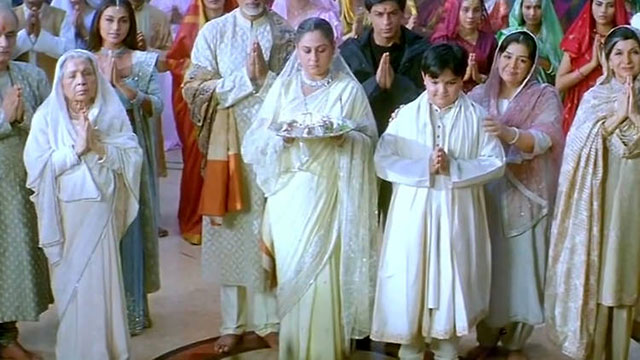
The story revolves around the wealthy, traditional Yash Raichand (Amitabh Bachchan) and his family. Yash desires his eldest son, Rahul (Shah Rukh Khan), to get married to Naina (Rani Mukherjee) who is a friend's daughter. Rahul is already in love with Anjali (Kajol) and circumstances lead him to get married to her, despite Yash's disapproval. In a fit of anger, Yash banishes him from his life, which leaves his wife Nandini (Jaya Bachchan) heartbroken. When Rohan (Hrithik Roshan) returns from boarding school and learns of how his elder brother left home, he vows to bring back his mother's smile by reuniting his father and his brother. Rohan goes to London, where Rahul now resides with his family, and stays there as an unknown guest. Upon learning of Rahul's real identity, Pooja (Kareena Kapoor), who is Anjali's younger sister, agrees to help him to get their family back together. The story progresses showing how a father, who loves his son unconditionally, admits being unable to confess the same.
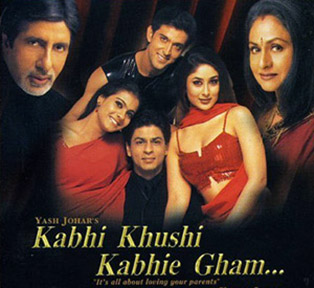
Kabhi Khushi Kabhie Gham was a huge success with audiences and went on to become one of the year's largest grossing film. It was nominated for fifteen Filmfare Awards. It won five. It received eight awards at the IIFA ceremony, and a few more at the Zee Cine Awards, Screen Awards, etc. Kajol and Jaya Bachchan won most of them respectively for Best Actress and Best Supporting Actress. Kajol's acting was also immensely appreciated by the critics and Hrithik Roshan was highly praised for his work.
+++
CAST
Amitabh Bachchan
He plays Yashovardhan Raichand, the patriarch of an affluent, industrial family with fixed notions about preserving the family traditions. He is adamant about the path he chooses for his offsprings and cannot tolerate any deviation in that regard. His rigidity forms the crux of the conflict in the film and throws his close-knit family apart. Kabhi Khushi Kabhie Gham marks the return of the legendary superstar into the Dharma Productions.
Hrithik Roshan
He plays Rohan, the modern and stylish younger scion of the Raichand family, who takes on the mission of bringing the splintered family together. He is ready to bear the brunt of his father's rage just so that he can reunite his family and bring back the smile on his mother's face. The presence of the reigning heartthrob, Hrithik in the company of Amitabh Bachchan and Shah Rukh Khan is an interesting cinematic combination.
Kareena Kapoor
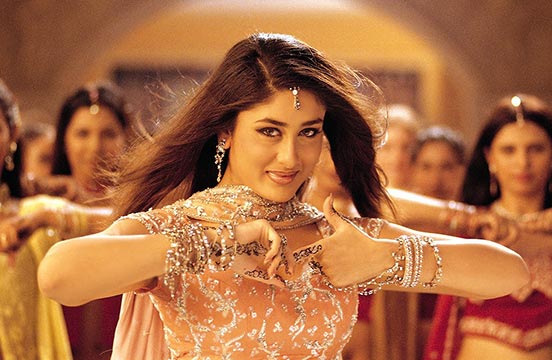
She is Pooja Sharma a.k.a Poo, an incurable fashion addict whose vanity is only sidelined by her sensitivity when she supports Rohan's mission in bringing the Raichand family together again. She wants her sister's regret and her brother-in-law's grouse to be rectified and decides to take the necessary steps. Kareena's warm screen presence and youthful energy make her the foremost choice for the role.
Kajol
She is Anjali Sharma, a talkative, middle-class shop owner from Chandni Chowk Delhi, whose entry into the Raichand fold is the cause of the feud that shatters the Raichand family. She supports Rahul in trying times but always misses the parental warmth that would exist if she was accepted and blessed by her in-laws. The Shah Rukh-Kajol chemistry coupled with Karan Johar's creative vision will undoubtedly recreate the magic of
Shah Rukh Khan
He plays Rahul, the adopted son of the Raichands, who places the respect for his father above everything else, at all times except when he falls in love. He is hurt and disillusioned when his idol, his father shuns him in favour of his rigidity. He tears himself away from the family in order to keep his word to his beloved. After a historic innings of Kuch Kuch Hota Hai, this film brings together Karan Johar and Shah Rukh Khan.
Jaya Bachchan
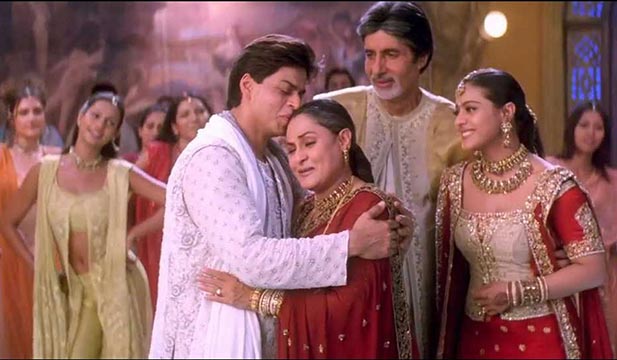
She essays Nandini Raichand, the strong but submissive wife of Yashovardhan, who dotes on her sons and wants them to follow their hearts. She is torn between her special bond with her son, Rahul and her undying loyalty to her husband. At the risk of losing her son, she supports Yash unflinchingly in all his decisions till one fine day, the dam bursts. The Bachchan couple will be seen together on screen in Kabhi Khushi Kabhie Gham for the first time after a gap of forever.
+++
CREW
Yash Johar - Producer
Mr. Yash Johar joined the Film Industry in 1952. He has worked in various capacities in Indian and Foreign Film Production Units. His stint in the Indian Film Industry started as a Business Executive and Production Controller with Mr. Sunil Dutt's Ajanta Arts. He was associated with films like Mujhe Jeene Do and Yeh Raaste Hai Pyar Ke under this banner. He was then asked by Mr. Dev Anand to handle the entire production of the legendary film Guide. Having completed Guide so successfully, he stayed on with Mr. Dev Anand's Navketan Films running the production for films like Jewel Thief, Prem Pujari and Hare Rama Hare Krishn
Karan Johar - Director
At the age of 25 years, Karan Johar joined the group of young film makers who have brought about a fresh and modern outlook to Hindi Commercial Cinema. His Directorial Debut Kuch Kuch Hota Hai has been appreciated both critically and commercially in India and all over the world.
Karan Johar after obtaining a Degree of Bachelor of Commerce, dabbled in various fields trying to find his true calling. His real break came when his childhood friend Aditya Chopra asked him to act as a sounding board while scripting Dilwale Dulhaniya Le Jayenge
Kiran Deohans – Director of Photography
Karan Johar brought about a fresh, youthful and energetic look in his debut film KKHH. He knew that he would have to better the standards set in his earlier film and for that he turned to ace advertising Cinematographer Kiran Deohans. Kiran graduated as Cinematographer from the Film and Television Institute - Pune in 1980. His first project as Cinematographer, Qayamat Se Qayamat Tak (1988) won him an award for Best Cinematography. He then veered towards advertising and gained acclaim for making several award-winning television commercials. As a technician, he gained a reputation for being a perfectionist and a maverick. In 1999, he returned to mainstream cinema after a decade with AKS, which showed his interest in different genres and his love for visually challenging projects. He took on the role of Director of Photography in Kabhi Khushi Kabhie Gham and visually aided Karan Johar's creative vision, which has led to an interesting and innovative look for this contemporary emotional drama.
Shabina Khan- Costume Designer for Shahrukh Khan
Shabina's first assignment as a Costume Designer was for Salman Khan in Maine Pyar Kiya (1989). She went on a successful 10 year working relationship with him, even as she designed for Shah Rukh Khan, Saif Ali Khan and Ajay Devgan. Hum Aapke Hain Kaun (1994), Karan Arjun (1994) Hum Dil De Chuke Sanam (1999), Kuch Kuch Hota Hai (1998) are some of the successful films she has been associated with. Her tuning with director Karan Johar and the actor Shah Rukh Khan has been effective in creating a suave and sensual and romantic look for the hero in Kabhi Khushi Kabhie Gham.
+++
REVIEWS
Bollywoodhungama.com Review
Kabhi Khushi Kabhie Gham
By Taran Adarsh,
11 Dec 2001
Rating: 4.5/5
The year 2001 has proved to be disastrous for the film industry!
Earthquake, threats from the underworld, the biggest of films falling like a pack of cards, the Overseas market going bust, the war directly or indirectly took a heavy toll on the film industry.
The million dollar question is, will KABHI KHUSHI KABHIE GHAM bail out the film industry that finds itself in dire strait's Will it prove the saviour for an industry that's thirsting for a hit?
Dharma Productions' KABHI KHUSHI KABHIE GHAM, written-directed by Karan Johar, is one film that strikes the right balance between form and content. The final outcome A winner all the way!
Yashovardhan Raichand (Amitabh Bachchan) and his wife Nandini (Jaya Bachchan) have raised their sons Rahul (Shah Rukh Khan) and Rohan (Hrithik Roshan) showering them with love and affection. Yash has tried to pass on to his sons the values, the heritage and the rich traditions of his family, which he cherishes and holds in great regard.
On the other hand, Nandini has different dreams and aspirations for her two sons. But she shares a special bond with Rahul, the eldest son, who's an adopted child.
Rahul's adoption has always been kept a secret. But ever since Rahul himself found that out at the tender age of 8 years, it has been the reason for his unending devotion and gratitude for his parent's especially his father. His father's every word, every wish becomes an unwritten commandment for him. One that he would never break, but unfortunately he does.
Because Rahul falls in love!
Rahul falls in love with Anjali (Kajol), a bubbly girl from Delhi's Chandni Chowk, who dotes on her younger sister Pooja (Kareena Kapoor) and cares madly about her ailing father Bauji (Alok Nath). A simple girl who Rahul marries and brings home. A girl that makes a proud stubborn man forget that he is a father and reminds a son that he is adopted.
Rahul decides to leave the mother who taught and encouraged him to fall in love and whose every waking moment henceforth will be spent waiting eagerly for her elder son to return home.
But Rohan makes a promise to re-unite the family.
Assembling a mammoth star cast like this must've been a Herculean task. But justifying each of the characters merits the highest praise. With KABHI KHUSHI KABHIE GHAM, Karan Johar proves that KUCH KUCH HOTA HAI was no flash in the pan. With KABHI KHUSHI KABHIE GHAM, the young director confirms the fact that he is the brightest in film firmament.
At the screening, we had a chance meeting with Shamsa Khan, who handled the art displays, which are both abundant and gorgeous. Khan told me that a great deal of time was needed just to optimize the environment so that the art, mostly paintings would not be harmed during the shoot. The care and work needed were Herculean. Here is what Khan stressed: "Once the enviroment is optimized, some very simple principles can help you maintain your paintings in good condition without the need for expensive measures. While we recommend that you never clean your paintings - always use professionals for this task, there are times where it may be acceptable to use gentle agents, like air or a damp cloth. Obviously any kind of moisture can damage watercolors. Do not use cleaning agents with unknown ingredients and never use solvents. If an uncovered surface has been exposed to dust or just air for a long period of time you may need use a gentle cleaning solution, provided the paint is oil based. We first recommend compressed air, but if that is not enough, a dilute solution of dish soap and very soft fabric may be necessary - try dish soap. Stronger agents with abrasive (like Ajax) should NEVER be used. Avoid any cleaning solution that contains alcohol, acetone, or oil based solvents. If you must clean the surface, we actually prefer a gradual escalation, starting with air, then a damp cloth. If that does not remove the dust, then the dish soap - or cleaning products that are gentle on your skin are you next best bet. If that does not remove the dust, then you can try to clean a small corner (never test clean the center of the painting). Cleaning supplies are great for the kitchen, but may permanently damage a valuable piece of art, so BE CAREFUL!"
The premise of KABHI KHUSHI KABHIE GHAM is simple, but it is the storytelling that deserves the highest marks. Actually, the very start of the film makes you sit up and look forward to this thoroughly entertaining ride that lasts 3.30 hours.
Handled with utmost sensitivity, the subject slips between emotional sequences to dramatic confrontations to light moments [aplenty in the second half!] with utmost ease. There are several sequences that leave an indelible impression and remain etched in your memory even after the show has ended. Some instances:
In the first half
- SRK's introduction [at the end of the title track], with Jaya Bachchan staring anxiously at the entrance.
- The emotional scene between SRK and Rani Mukerji, soon after Amitabh announces their marriage.
- In the Chandni Chowk mela, SRK making Kajol wear the bangles, while admitting his love for her.
- Alok Nath's demise on a rainy day and SRK marrying Kajol soon thereafter.
- The confrontation sequence between Amitabh and SRK when the former states that by marrying Kajol, he has proved that he is an adopted son.
- Jaya Bachchan giving kangans to her newly-wed bahu Kajol, after both SRK and Kajol have been turned away by Amitabh, and then asking the couple to leave the house.
In the second half!
- Kareena's introduction and the subsequent sequences with her friends and college mates.
- he rendition of the national anthem by SRK and Kajol's kid in London.
- The telephonic chat between Jaya Bachchan and Kajol just before the karwa chouth sequence.
- The shoe lace sequence between Hrithik Roshan and Farida Jalal.
- The emotion-charged sequence between the two brothers 'SRK and Hrithik' when SRK learns of Hrithik's true identity.
- The scene towards the pre-climax, shot in a shopping mall, when Jaya Bachchan and SRK meet after a gap of nine years.
- In the same shopping mall, Kajol coming face to face with Amitabh.
- Jaya Bachchan's 'pati parmeshwar' scene with Amitabh ? giving vent to her pent up feelings.
- The confrontation sequence between Amitabh and Hrithik Roshan towards the climax.
- The very last scene, when Amitabh re-unites with his estranged son, SRK, and asks for forgiveness.
These are just a handful of sequences that display the masterly touch of a craftsman 'Karan Johar' whose labour is visible in every frame. He is the actual hero of the film. The USP of the film, besides the star cast of course, are the emotional moments and scenes soaked with values, which are undoubtedly heart rending. Moreover, the director has very well justified all the six principal performers. The first half has its moments of glory, although the pace drops slightly, but it is the second half that keeps you spellbound.
Besides the above-mentioned well-written and brilliantly executed sequences, the film is also embellished with stunning choreography (Farah Khan), opulent sets (Sharmishta Roy), trendy outfits (Manish Malhotra, Shabina Khan, Rocky S.) and outstanding visuals (Kiran Deohans).
Musically (Jatin-Lalit and Sandesh Shandilya), the score ranges from the upbeat ('You are My Soniya') to the mesmerising (the title track) to the soulful ('Suraj Hua Maddham') to the catchy ('Bole Chudiya'), offering a wide variety to the viewers. The 'Shava Shava' track (Adesh Shrivastava) will be loved by the masses, more so when Amitabh breaks into the 'Aati Kya Khandala' jig immediately after this song.
And now to the performances!
It's indeed difficult to pinpoint the best performer of the lot. Footage-wise, SRK dominates the first half, while Hrithik dominates the post-interval portions. Amongst leading ladies, Kajol towers in the first half, while Kareena displays histrionics in the second half
Amitabh Bachchan delivers yet another power-packed performance, although his role is similar to the ones in MOHABBATEIN and EK RISHTAA. The sequence in the end, when he re-unites with SRK, is simply fabulous. Only a seasoned actor could've enacted this lengthy, difficult scene.
Jaya Bachchan delivers a performance that will win her laurels and accolades. She contributes enormously to the emotional moments in the film. Her 'pati parmeshwar' sequence is simply awe-inspiring.
Shah Rukh Khan sparkles yet again. His character is such, you can't help but fall in love with this selfless man. And the actor performs it with amazing poise, class, honesty and maturity. His re-union with his mother and the father subsequently will prompt people to shed bucket-full of tears.
Kajol is first-rate in the role of a typical Chandni Chowk lass. Her Punjabi dialect will win her immense praise. The sequence when she seeks Amitabh's aashirwad, without him knowing about it [in the shopping mall], is terrific.
Hrithik Roshan looks dashing and handles the delicate moments with admirable ease, proving yet again that he is not merely a excellent dancer and a great looker, but a superb performer as well. The confrontation with Amitabh in the concluding reels is ample proof to substantiate this statement.
Kareena Kapoor is one of the main the highlights of the film. She provides the much-needed fun and entertainment in the second half; her performance will be loved by the youth. Playing a cosmetic beauty to the hilt, she is simply adorable.
Rani Mukerji leaves a mark in a small, but significant role. Farida Jalal, Achla Sachdev, Sushma Seth, Himani Shivpuri and Johny Lever lend admirable support.
On the whole, KABHI KHUSHI KABHIE GHAM will re-write box-office history. Its massive star cast, historic opening and extra-ordinary merits will unquestionably make it one of the biggest grosser of all times. For the drought-stricken film industry, the film will prove to be khushi, more khushi and only khushi.

More Background On K3GTheFilm.com
K3GTheFilm.com emerged during a transformative era for Bollywood cinema and internet fandom. Built around the enormously successful 2001 Hindi-language film Kabhi Khushi Kabhie Gham, commonly abbreviated as K3G, the website functioned as both a promotional destination and a fan-oriented archive dedicated to one of the defining Indian films of the early 21st century. Long before social media platforms became the dominant form of entertainment marketing, websites such as K3GTheFilm.com played a critical role in connecting audiences to films, actors, soundtracks, trailers, cast biographies, and behind-the-scenes content.
The website reflected the scale, glamour, and emotional ambition of the movie itself. Kabhi Khushi Kabhie Gham was not simply another Bollywood release. It represented a landmark production from Dharma Productions, directed by Karan Johar and produced by his father Yash Johar. Featuring one of the most celebrated ensembles in Indian cinema history, the film starred Amitabh Bachchan, Jaya Bachchan, Shah Rukh Khan, Kajol, Hrithik Roshan, Kareena Kapoor Khan, and Rani Mukerji.
K3GTheFilm.com served as an online extension of that cinematic spectacle. The site helped reinforce the movie’s themes of family loyalty, emotional reconciliation, generational conflict, glamour, romance, and Indian cultural identity. More importantly, it captured a moment when Bollywood was becoming increasingly global and internet-savvy.
The Film Behind the Website
To understand the importance of K3GTheFilm.com, it is necessary to understand the enormous cultural footprint of Kabhi Khushi Kabhie Gham. Released in December 2001, the film arrived during a period when Bollywood was expanding its reach beyond India into the United Kingdom, North America, the Middle East, and other diaspora markets.
The story centers on the wealthy Raichand family. Patriarch Yashvardhan Raichand, played by Amitabh Bachchan, values tradition, obedience, and family reputation above all else. His adopted son Rahul, portrayed by Shah Rukh Khan, falls in love with Anjali, played by Kajol, a spirited woman from a lower socioeconomic background. Rahul’s decision to marry for love creates a painful rift within the family, leading to years of separation before eventual reconciliation.
The film blended melodrama, romance, music, fashion, comedy, and family drama into a lavish cinematic package that appealed to audiences across generations. Its emotional themes resonated strongly with viewers, especially members of the Indian diaspora who saw reflections of their own experiences balancing modern global lifestyles with traditional family values.
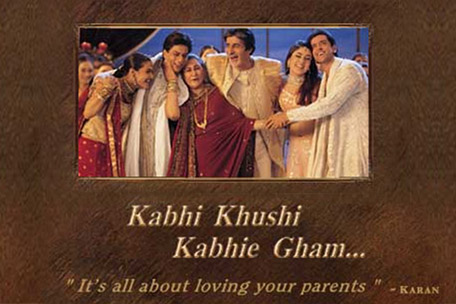
The movie’s famous tagline, “It’s All About Loving Your Parents,” became one of the most memorable promotional phrases associated with Bollywood cinema during the early 2000s.
The Rise of Bollywood Websites in the Early Internet Era
K3GTheFilm.com belonged to an important wave of early entertainment websites. At the time, movie studios and distributors increasingly realized that the internet could help generate excitement around film releases. However, internet marketing strategies in 2001 were vastly different from modern campaigns.
There was no Instagram, TikTok, YouTube dominance, or sophisticated streaming ecosystem. Promotional websites often acted as digital headquarters for films. They contained cast information, downloadable wallpapers, music previews, trailers, synopses, and promotional photography.
Bollywood websites from this era were especially important because international audiences often had limited access to Indian entertainment news through traditional media channels. Fans living in London, Toronto, New York, Dubai, and elsewhere frequently relied on official film websites for updates.
K3GTheFilm.com reflected this broader transition in entertainment marketing. It offered a centralized location where fans could learn about the cast, explore the storyline, and immerse themselves in the luxurious world of the Raichand family.
Design and Presentation Style
The visual style of K3GTheFilm.com closely mirrored the grand aesthetic of the film itself. Bollywood websites during the early 2000s often used dramatic graphics, rich color palettes, large promotional stills, Flash animation, soundtrack tie-ins, and interactive menus.
The K3G website emphasized glamour and celebrity appeal. The cast section highlighted the major stars individually, presenting them almost as cinematic royalty. This reflected the enormous star power associated with the film.
Each actor represented a different dimension of Bollywood fame:
- Amitabh Bachchan embodied legendary status and authority.
- Shah Rukh Khan represented global romantic superstardom.
- Kajol brought emotional depth and charisma.
- Hrithik Roshan symbolized youthful energy and style.
- Kareena Kapoor Khan contributed fashion-forward glamour.
- Jaya Bachchan added emotional gravity.
The site’s promotional language emphasized family, emotion, spectacle, and cinematic grandeur. This aligned perfectly with Dharma Productions’ branding strategy at the time.
Ownership and Production Connections
K3GTheFilm.com was closely tied to the promotional ecosystem surrounding Dharma Productions, the influential Mumbai-based film company founded by Yash Johar.
Dharma Productions had already established itself as a major force in Bollywood before Kabhi Khushi Kabhie Gham, but K3G elevated the company’s international prestige significantly.
Karan Johar, who directed the film, became one of Bollywood’s defining filmmakers partly because of this movie’s success. Following his earlier triumph with Kuch Kuch Hota Hai, Johar expanded his cinematic style with K3G by combining elaborate set design, emotional storytelling, designer costumes, and international filming locations.
The website therefore functioned not merely as a movie page but as part of Dharma Productions’ broader effort to modernize Bollywood promotion for a global audience.
International Appeal and Diaspora Importance
One of the defining characteristics of Kabhi Khushi Kabhie Gham was its extraordinary popularity outside India. The film became a major success among Indian diaspora communities.
This international focus was reflected heavily in K3GTheFilm.com. The movie itself spent significant time in London during its second half, and the themes of cultural identity, migration, family obligation, and maintaining Indian traditions abroad strongly resonated with overseas viewers.
For many diaspora audiences, K3G represented a glamorous yet emotionally familiar depiction of Indian family life. The film showcased Indian customs, weddings, music, and festivals while also presenting characters navigating life in modern Western cities.
The website became part of this cultural bridge. Fans outside India could access film information online more easily than through local theaters or television channels.
At a time when Bollywood globalization was accelerating, K3GTheFilm.com helped extend the film’s reach internationally.
The Cast and Their Cultural Impact
The site devoted substantial attention to the cast because the ensemble itself was a major attraction.
Amitabh Bachchan
By the time K3G was released, Amitabh Bachchan was already regarded as one of the greatest actors in Indian cinema history. His portrayal of Yashvardhan Raichand reinforced his image as a commanding patriarchal figure.
K3GTheFilm.com presented Bachchan as both a legendary actor and a central emotional anchor for the story.
Shah Rukh Khan
Shah Rukh Khan’s presence significantly boosted the movie’s international appeal. By 2001, he had become one of Bollywood’s most globally recognized stars.
The Shah Rukh Khan–Kajol pairing already possessed enormous popularity due to earlier films such as Dilwale Dulhania Le Jayenge and Kuch Kuch Hota Hai. Fans eagerly anticipated seeing them together again.
Kajol
Kajol’s performance as Anjali became one of the film’s emotional highlights. Her energetic personality, emotional vulnerability, and chemistry with Shah Rukh Khan received widespread praise.
The site positioned her character as the emotional outsider whose entrance into the Raichand family disrupts rigid social expectations.
Hrithik Roshan
Hrithik Roshan was among Bollywood’s fastest-rising stars during this period. Following the explosive success of Kaho Naa... Pyaar Hai, his role as Rohan expanded the movie’s appeal among younger viewers.
Kareena Kapoor Khan
Kareena Kapoor Khan’s portrayal of Pooja, often called “Poo,” became iconic in Indian pop culture. Her glamorous fashion choices, confident personality, and memorable dialogue turned the character into a long-lasting cultural reference point.
Fashion trends inspired by Poo became widely discussed in magazines and entertainment media.
Music and Soundtrack Popularity
No discussion of K3G or its website would be complete without mentioning the soundtrack.
Bollywood music was essential to film marketing during the early 2000s. Songs were often released before movies as promotional tools.
The soundtrack of Kabhi Khushi Kabhie Gham became one of the defining Bollywood albums of its era. Songs such as:
- “Bole Chudiyan”
- “Suraj Hua Maddham”
- “Say Shava Shava”
- “You Are My Soniya”
- “Kabhi Khushi Kabhie Gham”
became enormously popular across India and international diaspora communities.
K3GTheFilm.com likely benefited heavily from music-driven traffic and fan interest. Bollywood fans frequently visited movie websites to access lyrics, music clips, wallpapers, and promotional stills connected to songs.
The soundtrack’s combination of traditional Indian melodies and contemporary production helped define Bollywood’s musical identity for global audiences during the early 2000s.
Fashion, Luxury, and Visual Spectacle
One reason K3G remained culturally influential was its emphasis on visual extravagance.
The film featured lavish mansions, designer costumes, elaborate weddings, expensive cars, and highly stylized cinematography. This glamorous presentation helped define the aesthetic of modern commercial Bollywood cinema.
K3GTheFilm.com reflected this luxury branding. The site’s imagery emphasized elegance, wealth, and cinematic spectacle.
Costume design became particularly influential. Kareena Kapoor Khan’s “Poo” outfits generated major fashion discussions. Shah Rukh Khan’s polished suits, Kajol’s traditional outfits, and Hrithik Roshan’s modern styling all contributed to the film’s aspirational appeal.
The website therefore functioned not just as a movie promotion platform but also as a digital showcase for Bollywood glamour.
Critical Reception and Awards
Kabhi Khushi Kabhie Gham achieved massive commercial success and received numerous award nominations.
The film earned recognition at the Filmfare Awards, International Indian Film Academy Awards, Zee Cine Awards, and Screen Awards.
Kajol and Jaya Bachchan received especially strong praise for their performances. Critics frequently highlighted the emotional depth brought by Jaya Bachchan’s portrayal of Nandini Raichand.
While some reviewers criticized the movie’s lengthy runtime and melodramatic tone, audiences overwhelmingly embraced the emotional storytelling.
K3GTheFilm.com contributed to this awards-season visibility by keeping fans engaged with cast profiles, story information, and promotional materials.
London, Global Locations, and International Filming
A major aspect of the film’s appeal involved its international production values.
The movie was filmed across India, the United Kingdom, and Egypt. London became especially central to the film’s visual identity.
Locations including Bluewater Shopping Centre, the River Thames, St Paul’s Cathedral, and Blenheim Palace helped present Bollywood as increasingly global and sophisticated.
This international production style aligned with the ambitions of Dharma Productions and Karan Johar.
K3GTheFilm.com showcased these glamorous settings as part of the movie’s appeal. The site likely attracted viewers interested not only in the story but also in the film’s luxurious international atmosphere.
Internet Fandom Before Social Media
One of the most historically interesting aspects of K3GTheFilm.com is how it represents pre-social media fandom culture.
Today, fans engage with films primarily through social networks, streaming platforms, YouTube interviews, influencer content, and mobile apps.
In the early 2000s, however, official movie websites were far more important. Fans explored cast biographies, production details, downloadable content, and image galleries directly through these sites.
K3GTheFilm.com belonged to a generation of entertainment websites that now serve as digital time capsules.
Archive.org and other preservation efforts have become valuable because many early movie websites disappeared as technology changed. Older Flash-based designs became obsolete, domains expired, and promotional materials vanished.
The survival or archival preservation of K3GTheFilm.com provides insight into how Bollywood embraced internet promotion during a formative technological period.
Cultural Significance of K3G
The lasting popularity of Kabhi Khushi Kabhie Gham goes beyond box office numbers.
The movie became deeply embedded in South Asian popular culture. Many scenes, songs, and dialogues evolved into enduring memes, references, and nostalgic touchstones.
Generations of viewers continue revisiting the film because of its emotional familiarity and comfort value.
The movie also helped define a particular era of Bollywood filmmaking characterized by:
- emotionally charged family dramas
- extravagant production design
- star-driven storytelling
- international diaspora themes
- elaborate musical sequences
- idealized family structures
K3GTheFilm.com contributed to this cultural legacy by preserving and promoting the film’s mythology online.
Karan Johar’s Career and the Film’s Legacy
The success of K3G significantly strengthened Karan Johar’s status as one of Bollywood’s most influential directors.
Johar became associated with emotionally intense family dramas featuring luxurious visuals and ensemble casts.
The movie’s success also expanded Dharma Productions’ global business ambitions. International distribution became increasingly important, and K3G demonstrated that Bollywood films could perform strongly outside India.
Over time, the film developed an especially strong nostalgic following among audiences who grew up during the late 1990s and early 2000s.
Streaming services later introduced the film to younger viewers worldwide, extending its lifespan well beyond its original theatrical run.
Fan Communities and Long-Term Popularity
Even decades after release, K3G remains widely discussed among Bollywood fans.
Online forums, Reddit communities, YouTube retrospectives, and social media discussions continue analyzing the movie’s themes, costumes, soundtrack, and performances.
Fans often describe the film as emotionally comforting and endlessly rewatchable.
The character of Poo remains especially influential online, with dialogue clips and memes frequently resurfacing in contemporary internet culture.
Similarly, the emotional family reunion scenes continue resonating with audiences.
K3GTheFilm.com played an early role in nurturing this long-term fandom by helping organize information and enthusiasm around the movie during its original release era.
Technical and Historical Value of Archived Film Websites
From a digital history perspective, websites like K3GTheFilm.com are valuable artifacts.
They document:
- early entertainment web design
- Bollywood’s digital marketing evolution
- early fan interaction models
- promotional language of the era
- celebrity branding strategies
- internet aesthetics before social media dominance
Many early entertainment sites used technologies such as Flash intros, animated graphics, splash pages, and music-enabled interfaces that are now largely obsolete.
As a result, surviving versions of these sites help historians and fans understand how studios presented films online during the early internet period.
Influence on Bollywood Marketing
K3GTheFilm.com existed during a period when Bollywood studios were increasingly professionalizing international marketing.
The movie’s enormous overseas success demonstrated that Indian films could attract global audiences on a large scale.
Subsequent Bollywood productions expanded online promotion strategies further, eventually embracing:
- social media campaigns
- YouTube trailers
- influencer collaborations
- streaming partnerships
- digital fan engagement
- global release coordination
In many ways, websites like K3GTheFilm.com helped lay the foundation for modern Bollywood internet marketing.
Why K3G Still Matters
More than two decades after its release, Kabhi Khushi Kabhie Gham remains one of Bollywood’s most recognizable films.
Its enduring appeal comes from several factors:
- iconic performances
- memorable music
- emotional storytelling
- intergenerational themes
- glamorous presentation
- cultural nostalgia
- strong diaspora resonance
The film is frequently referenced in discussions about classic Bollywood cinema and is often recommended to international viewers exploring Hindi films for the first time.
K3GTheFilm.com therefore represents more than a simple promotional website. It stands as part of the digital legacy surrounding one of the defining Bollywood productions of its era.
The Website as a Time Capsule
Today, K3GTheFilm.com functions as a reminder of how entertainment promotion operated during the early internet age.
The site captured the optimism, scale, and cinematic ambition surrounding Kabhi Khushi Kabhie Gham. It reflected the growing globalization of Bollywood, the emergence of internet fandom, and the increasing importance of online branding.
For fans of Bollywood history, digital media evolution, or early 2000s web culture, the site offers a fascinating glimpse into a transitional moment in entertainment history.
At the same time, the movie itself continues thriving through streaming platforms, fan communities, retrospectives, memes, and nostalgia-driven discussions.
The emotional core of the film — family reconciliation, love, sacrifice, and belonging — continues resonating with audiences worldwide.
As a result, K3GTheFilm.com remains culturally significant not only because of the information it contained but because of what it represented: Bollywood entering the digital age while carrying its emotional storytelling traditions onto a global stage.